
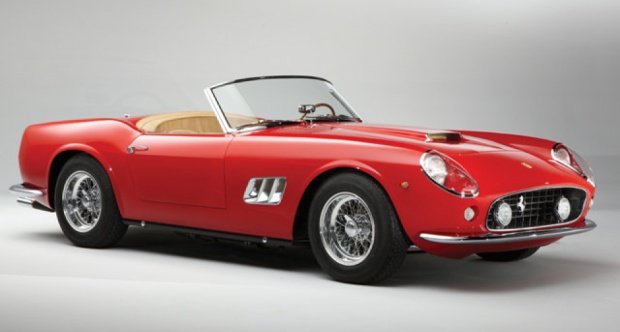
Thanks to Ferrari's renowned reputation in motorsports and the efforts of importer Luigi Chinetti, the United States emerged as a significant market for the brand.
Recognising the potential demand in California, John Von Neumann, the representative on the west coast, envisioned the creation of an open Spider model that would perfectly suit the sunny Californian climate. Essentially, he imagined an open-top variant of the 250 GT Berlinetta.
Renowned coachbuilder Scaglietti in Modena was tasked with constructing these cars. Most of them were built with steel bodies featuring aluminium opening panels, although a few were entirely crafted from aluminium. These "LWB" (Long Wheelbase) models were constructed on a 2600 mm chassis, identified by factory reference numbers 508C and 508D, as seen in the "TdF" berlinettas. They were assigned odd chassis numbers within the road car sequence and had a "GT" suffix. Generally, their construction followed the same principles as the contemporary berlinettas, including mechanical components like suspension, brakes, and steering. All examples produced were left-hand drive.
The majority of "LWB" cars were equipped with a single overhead camshaft per bank 3-liter V12 engine, referred to by factory type references 128C and 128D. These engines had a displacement of 2953 cc, with a bore and stroke of 73 mm x 58.8 mm. The spark plugs were positioned within the Vee of the engine block, and the specifications closely resembled those of the concurrent berlinettas.
Early models featured a single coil and distributor ignition system, later replaced by a twin coil and distributor arrangement, which boosted the claimed horsepower to 260 bhp. The bodies of the subsequent "SWB" (Short Wheelbase) series of cars closely resembled those of the preceding "LWB" versions. However, they were mounted on a new 2400 mm wheelbase chassis, initially identified by factory reference numbers 539 and then 539/61, similar to the concurrently produced "SWB" berlinettas.
The new chassis design reduced the overall height of the car by 30 mm, giving it a slightly more squat appearance compared to the earlier versions. However, differentiating between the two can still be challenging. As for the engines, certain examples of both the long and short wheelbase cars enjoyed successful careers in competition, possibly due to drivers' preference for an open GT car over a closed one or as a means to promote the model through racing.
One of the most accomplished drivers in a 250 GT California in competition was Bob Grossman from the United States. He achieved notable success, including a fifth-place overall finish at Le Mans in 1959, co-driving with Fernand Tavano in the "LWB" chassis 1451 GT. Grossman also achieved numerous impressive results in national races across the USA during 1959 and 1960, all behind the wheel of this car.
Ferrari 250 California Technical Specifications
| ENGINE | ||
| type | front, longitudinal 60° V12 | |
| bore/stroke | 73 x 58.8 mm | |
| unitary displacement | 246.10 cc | |
| total displacement | 2953.21 cc | |
| compression ratio | 8.5 : 1 | |
| maximum power | 176 kW (240 hp) at 7000 rpm | |
| power per litre | 81 hp/l | |
| maximum torque | - | |
| valve actuation | single overhead camshaft per bank, two valves per cylinder | |
| fuel feed | three Weber 36 DCL carburettors | |
| ignition | single spark plug per cylinder, two coils | |
| lubrication | wet sump | |
| clutch | twin-plate | |
| CHASSIS | ||
| frame | tubular steel | |
| front suspension | independent, unequal-length wishbones, coil springs,hydraulic shock absorbers | |
| rear suspension | live axle, semi-elliptic springs, hydraulic shock absorbers | |
| brakes | drums | |
| transmission | 4-speed + reverse | |
| steering | worm and sector | |
| fuel tank | capacity 100 litres | |
| front tyres | 6.00 x 16 | |
| rear tyres | 6.00 x 16 | |
| BODYWORK | ||
| type | two-seater spider | |
| length | - | |
| width | - | |
| height | - | |
| wheelbase | 2600 mm | |
| front track | 1354 mm | |
| rear track | 1349 mm | |
| weight | 1100 kg (dry) | |
| PERFORMANCE | ||
| top speed | 252 km/h | |
| acceleration 0-100 km/h | - | |
| 0-400 m | - | |
| 0-1000 m | - | |
Ferrari 250 California Valuations
The 250 California is one of the most iconic and valued Ferrari's ever produced. Hagerty's Price Guide currently lists pricing for a 250 California as £14 Million for concourse condition car, £13 Million for a car in excellent condition, £12 Million for a car in good condition, and £11 Million for a car in fair condition.
Movie provenance will generally elevate a car's price up one or two categories, so a California Spider with no particular provenance at all will still command an eight figure price at auction. For example, during the Scottsdale 2017 auctions, a 1960 250 GT California Spider was passed in by Bonhams with a high bid of £8.6 Million, but failed to meet reserve.