
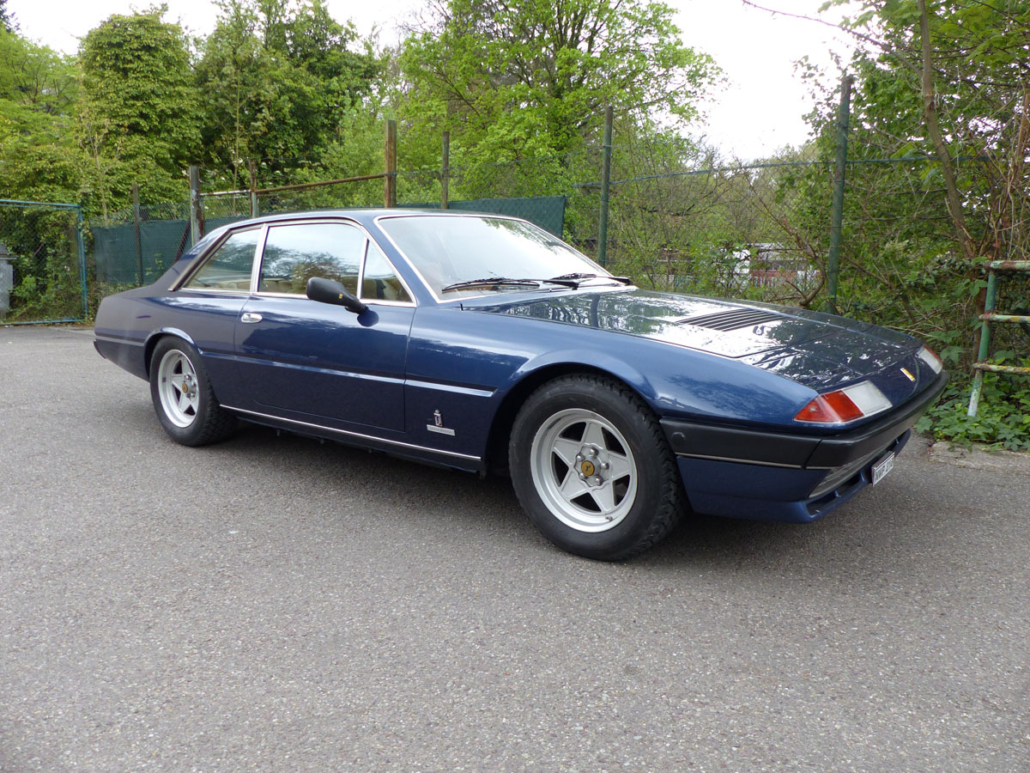
The 400 series replaced the 365 GT4 2+2 model at the 1976 Paris Salon, and for the first time a model with automatic transmission became available on a Ferrari production car, the 400 Automatic.
The engine of cars with the automatic gearbox had a factory type reference F 101 C 080. Two banks of three Weber side draught twin choke 38 DCOE 110-111 carburettors were fitted, with twin coil and rear of engine mounted distributors, to produce a claimed 340bhp.
Although the chassis of the 400 series cars was structurally virtually identical to the preceding 365 GT4 2+2 models, there were nominal differences, which resulted in a new factory reference number F 101 CL 180 for this automatic transmission version.
The 400 Automatic continued in production until November 1979, during which time 355 examples were produced in the chassis number range19353 to 28261. As with the 365 GT4 2+2, they were built and fully trimmed at the Pininfarina works in Turin, and then shipped to the Ferrari factory in Maranello for the installation of the mechanical components.
Ferrari 400 Automatic Technical Specifications
| ENGINE | ||
| type | front, longitudinal 60° V12 | |
| bore/stroke | 81 x 78 mm | |
| unitary displacement | 401.93 cc | |
| total displacement | 4823.16 cc | |
| compression ratio | 8.8 : 1 | |
| maximum power | 250 kW (340 hp) | |
| power per litre | 70 hp/l | |
| maximum torque | – | |
| valve actuation | twin overhead camshafts per bank, two valves per cylinder | |
| fuel feed | six Weber 38 DCOE carburettors | |
| ignition | single spark plug per cylinder, two coils | |
| lubrication | wet sump | |
| clutch | torque converter | |
| CHASSIS | ||
| frame | tubular steel | |
| front suspension | independent, unequal-length wishbones, coil springs over telescopic shock absorbers, anti-roll bar | |
| rear suspension | self-levelling, independent, unequal-length wishbones, coil springs over telescopic shock absorbers, anti-roll bar | |
| brakes | discs | |
| transmission | 3-speed automatic + reverse | |
| steering | power-assisted recirculating-ball | |
| fuel tank | capacity 120 litres | |
| front tyres | 215/70 VR 15 | |
| rear tyres | 215/70 VR 15 | |
| BODYWORK | ||
| type | 2+2 coupé | |
| length | 4810 mm | |
| width | 1796 mm | |
| height | 1310 mm | |
| wheelbase | 2700 mm | |
| front track | 1470 mm | |
| rear track | 1500 mm | |
| weight | 1700 kg (dry) | |
| PERFORMANCE | ||
| top speed | 240 km/h | |
| acceleration 0-100 km/h | – | |
| 0-400 m | 14.9 sec. | |
| 0-1000 m | 25.5 sec. | |
Ferrari 400 Automatic Valuation
The Ferrari 400 Automatic, produced between 1976 and 1985, has seen a steady rise in appreciation among collectors and enthusiasts in recent years—particularly for well-maintained, original examples.
Current Market Range (2025):
Fair condition (needs work or partially restored): £25,000–£35,000
Good condition (clean, running, some history): £35,000–£55,000
Excellent condition (fully restored or very original with history): £55,000–£75,000
Concours-level / rare spec / low mileage: £75,000–£90,000+
Key Factors Affecting Value:
Originality: Factory-correct interiors, paint, and drivetrain components are highly desirable.
History & Documentation: A well-documented service history, especially from marque specialists, adds significant value.
Condition of the automatic transmission: The GM-sourced 3-speed automatic is robust but parts and rebuilds can be costly.
Market sentiment: Once overlooked, the 400 Automatic is gaining recognition for its elegant design, V12 pedigree, and usability as a GT car.